THE PUBLIC TRUST
An Identity-Based Leadership System for Government Institutions
Strengthening ethical consistency, decision-making clarity, and institutional alignment by developing the internal standard that governs behavior under pressure.
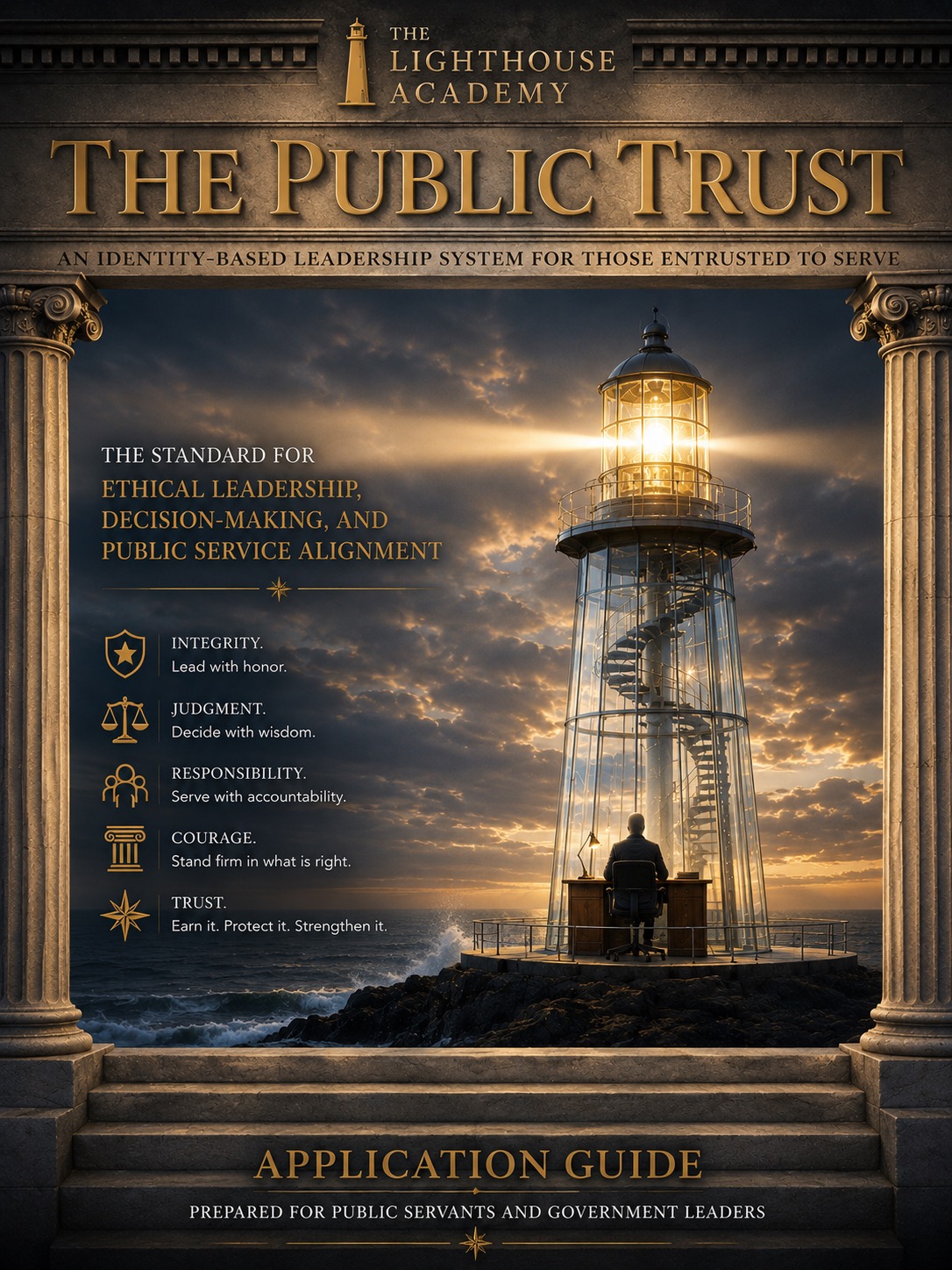
The Moment That Defines Public Trust
Not when policies are clear.
Not when oversight is present.
But in the moment when a decision must be made…
and no one is watching.
That is where trust is either reinforced… or quietly lost.
What Government Leaders Are Actually Managing
Government systems are not failing due to lack of policy. Most agencies operate with clearly defined procedures, compliance frameworks, and accountability structures.
The strain appears at the point of decision. Under pressure, ambiguity, and competing priorities, outcomes become inconsistent. Standards are interpreted differently. Judgment varies. Public confidence erodes.
- Inconsistent decision-making under pressure
- Ethical drift in ambiguous environments
- Overreliance on enforcement to maintain standards
- Variability across teams, departments, and leadership levels
- Erosion of public trust due to perceived inconsistency
These are not policy failures. They are human performance challenges at the moment of action.
The Core Insight
Policies guide behavior.
Identity determines behavior under pressure.
When conditions are unclear, time-sensitive, or politically charged, individuals do not default to policy manuals. They default to habits, internal narratives, perceived norms, and their personal standard.
The Public Trust Standard
The Public Trust introduces a central operational construct:
The internal benchmark a public servant uses to make decisions when rules are unclear, pressure is present, and oversight is absent.
Participants are trained to define, apply, and maintain this standard consistently, creating stability of behavior across environments rather than reliance on external enforcement.
How the System Works
15 Development Modules
Progressive capability building aligned to awareness, judgment, and behavioral consistency.
45 Real-World Scenarios
Quinn’s Corner simulations reflecting actual decision environments across public service.
Guided Practicums
Structured application of identity, decision patterns, and behavior under pressure.
Measurement System
Pre/Post assessment tracking decision consistency, alignment, and response patterns.
Measurable Outcomes
Short-Term
- Greater awareness of decision patterns
- Improved composure under pressure
- Clearer understanding of role responsibility
Intermediate
- Consistent application of ethical standards
- Stronger communication and professional conduct
- Reduction in reactive decision-making
Long-Term
- Stronger organizational culture
- Increased public confidence
- Alignment between values and behavior
Implementation Pathway
- Pilot Cohort: Baseline measurement and outcome validation
- Scaled Rollout: Department or agency-wide delivery with facilitator certification
- Sustained Integration: Embedded into leadership development systems
Strengthening the People Behind the Policy
The Public Trust does not replace policy, compliance, or leadership frameworks. It strengthens the individuals responsible for applying them.
Because when decision-making is consistent, aligned, and internally anchored, trust is not requested. It is earned.