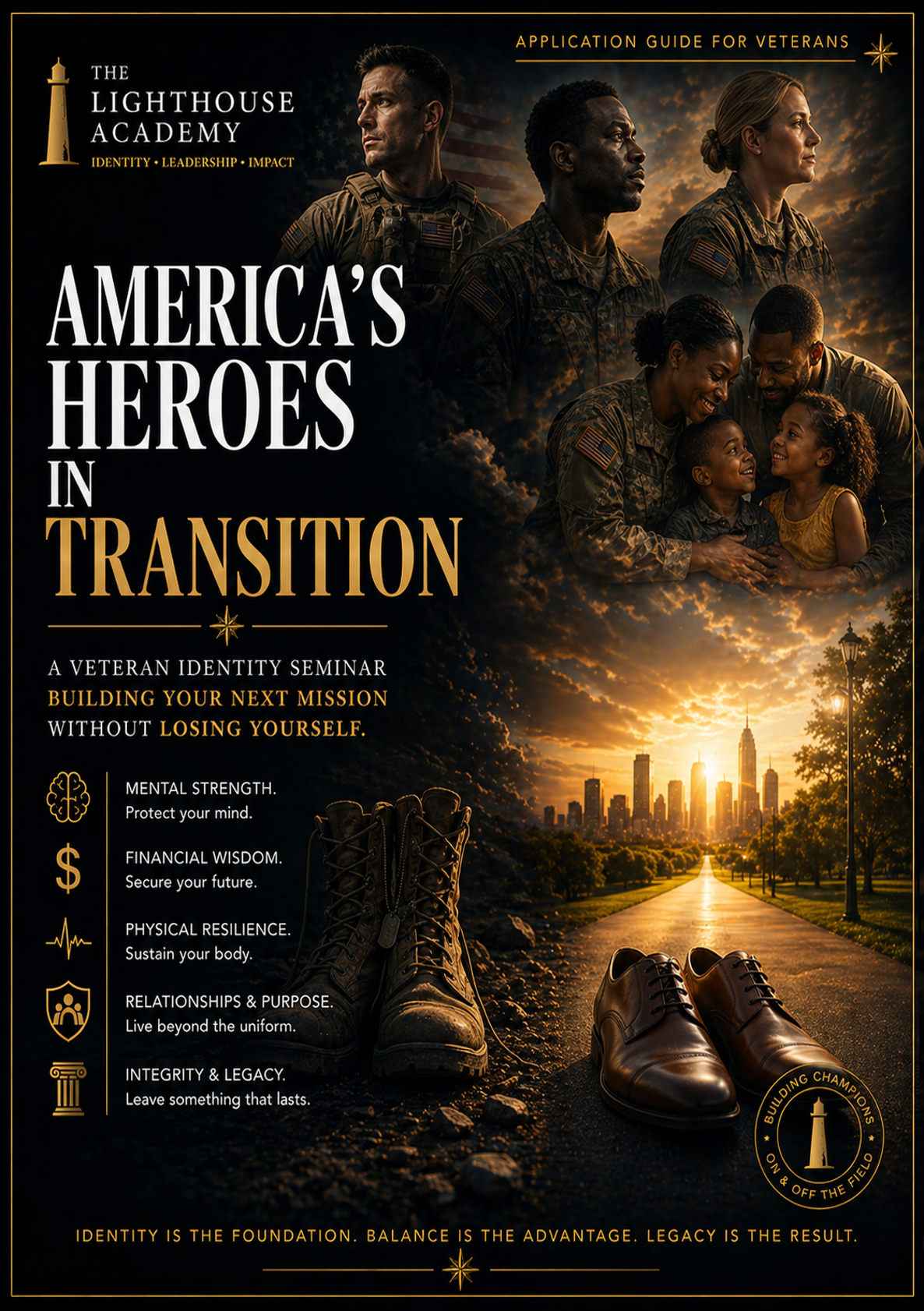
What Many Veterans Are Carrying After Service
The transition out of military life is rarely just occupational. It is personal, relational, neurological, and deeply tied to identity. Many veterans are navigating loss of mission, emotional shutdown, moral injury, family strain, hypervigilance, isolation, and the quiet question beneath them all: Who am I now that the uniform is gone?
Loss of Mission
Without a clear next mission, purpose can feel fractured and direction can fade.
Hypervigilance
The body may remain on alert long after the environment is no longer dangerous.
Identity Disruption
Rank, role, and brotherhood once anchored identity. Civilian life often does not.
Reintegration Strain
Family, work, and community life can become difficult when identity has not yet caught up to transition.
Rebuilding Identity Beyond the Uniform
America’s Heroes in Transition is an identity reconstruction and reintegration system created for United States service members, veterans, and those walking beside them. Its purpose is to help participants reclaim inner stability, restore self-authorship, and carry their strength into the next chapter of life with clarity, dignity, and purpose.
Rather than focusing on employment checklists, symptom management, or surface-level encouragement alone, the program addresses the internal source of reintegration by rebuilding identity, emotional regulation, meaning, and mission through The Creation Code framework.
Designed for the People and Systems Responsible for Reintegration
This program is built for veterans in transition and for the organizations, families, mentors, and communities committed to helping them rediscover meaning, connection, and a sustainable identity beyond service.
Veterans
Active duty members preparing to transition, recently separated veterans, and long-separated veterans still seeking renewal.
Families
Spouses, partners, caregivers, parents, and loved ones affected by the transition journey.
Organizations
Veteran-serving nonprofits, transition programs, community organizations, chaplaincy networks, and reintegration teams.
Guides
Facilitators, peer mentors, counselors, educators, clergy, and civic leaders helping veterans navigate the next chapter.
Defining Challenges This Program Directly Addresses
These are not isolated symptoms. They are interconnected signals that identity, nervous system safety, belonging, and future orientation need to be rebuilt together.
Loss of mission or purpose after service
Hypervigilance and difficulty down-regulating
Identity confusion beyond rank, role, or MOS
Family reintegration and relationship strain
Emotional shutdown, isolation, and silence
Moral injury, guilt, and unresolved grief
Difficulty trusting civilian environments
Fear of failure in work, identity, or relationships
Loss of brotherhood and belonging
Difficulty envisioning a meaningful next chapter
A Structured 15-Practicum Identity Reconstruction System
This is not a workshop alone. It is a structured identity development and reintegration system that combines story, reflection, Socratic dialogue, guided assessment, and trauma-aware facilitation to produce measurable internal shifts in how veterans think, feel, connect, and lead.
Story-Based Chapters
Each chapter creates shared meaning and lowers defensiveness before deeper reflection begins.
Participant Workbook
Fifteen practicums, personal reflection, preparation tools, and identity-based written integration.
Facilitator Guidance
Guide-from-the-side delivery, safety protocols, sensitive-disclosure guidance, and chapter staging.
Experiential Tools
Socratic dialogue, Quinn’s Corner, grounding practices, revision cycles, and identity anchoring tools.
A 7-Step Practicum Experience Built for Safety, Reflection, and Reintegration
Each chapter is delivered through a repeatable sequence that helps veterans move from guarded observation to reflection, shared insight, emotional regulation, and practical identity change.
1. Present the chapter by audio or live reading.
2. Move into private practicum reflection.
3. Open guided Socratic dialogue.
4. Enter Quinn’s Corner for reflected experience.
5. Continue post-Quinn integration dialogue.
6. Revisit and revise workbook responses.
7. Close with grounding and identity anchoring.
A Built-In Growth System That Measures Renewal Without Grading Identity
America’s Heroes in Transition now includes a more mature assessment architecture. Participants begin with a next-mission readiness baseline, complete a mirrored post-assessment at the end, and use a final growth scorecard to name where identity, self-talk, emotional regulation, purpose, and reintegration have shifted.
This allows organizations to show measurable internal growth while preserving dignity, privacy, and the deeper truth that human renewal is not a test score.
Pre-Assessment
Establishes a baseline across mission, authority, brotherhood, emotional control, readiness, discipline, identity, and sacrifice.
Post-Assessment
Mirrors the starting point so veterans can compare where they began to where they now stand.
Growth Scorecard
Helps participants describe the shifts they can now see in how they relate to themselves, others, stress, safety, and future purpose.
The Program Addresses the Source of Reintegration, Not Only the Symptoms
America’s Heroes in Transition works because it begins with safety, identity, and self-authorship. It honors military culture without trapping veterans inside it. It uses proxy-based dialogue and story to reduce shame, Socratic questioning to restore agency, and trauma-aware pacing to help insight move from thought into embodied change.
Restores nervous system safety before demanding change
Rebuilds identity beyond rank and role
Uses real questions and reflected experience rather than exposure
Guides veterans from silence to safe dialogue
Integrates workbook reflection, dialogue, and revision
Supports measurable internal growth without reducing people to numbers
Early Indicators of Identity and Reintegration Growth
When implemented with fidelity, this system strengthens veterans and the systems around them by improving how they regulate, relate, reflect, and re-engage with civilian life.
Short-Term
Reduced reactivity, increased emotional awareness, deeper reflection, and safer dialogue.
Intermediate
Stronger identity coherence, healthier self-talk, better family connection, and improved reintegration into work and community.
Long-Term
Greater resilience, renewed purpose, restored dignity, and a clearer sense of mission in civilian life.
It begins when identity is rebuilt beyond the uniform.
Bring America’s Heroes in Transition to the Veterans You Serve
For transition programs, veteran-serving organizations, communities, and leaders ready to support reintegration through identity, not reaction.
This is not just a veteran seminar. It is psychological infrastructure for national reintegration.